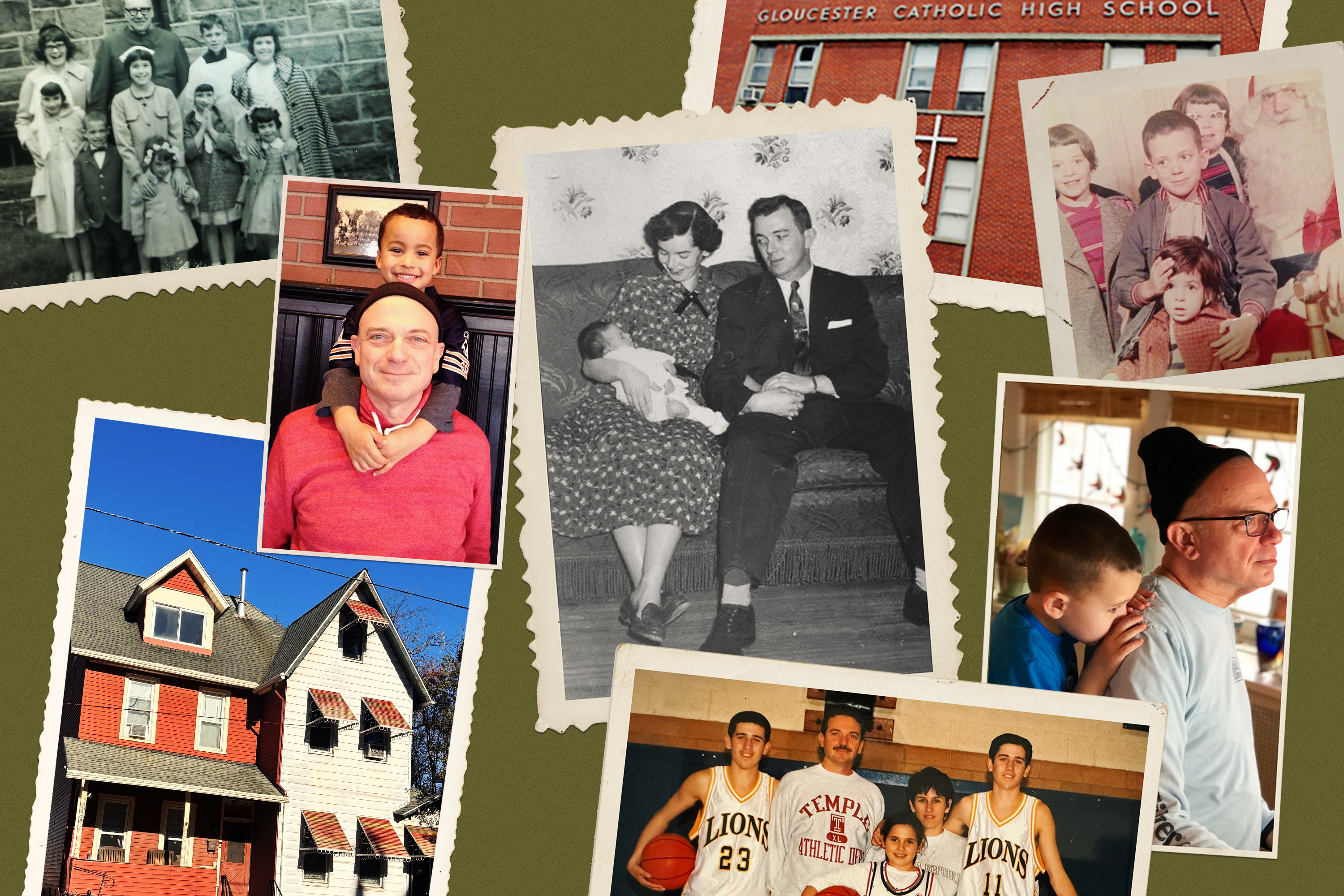
Joe Gorman was a teacher, counselor, historian, author, and coach who touched thousands of lives. Said Rosemary Healey: “If Joe Gorman didn’t go straight to heaven, you and I don’t stand a chance.”
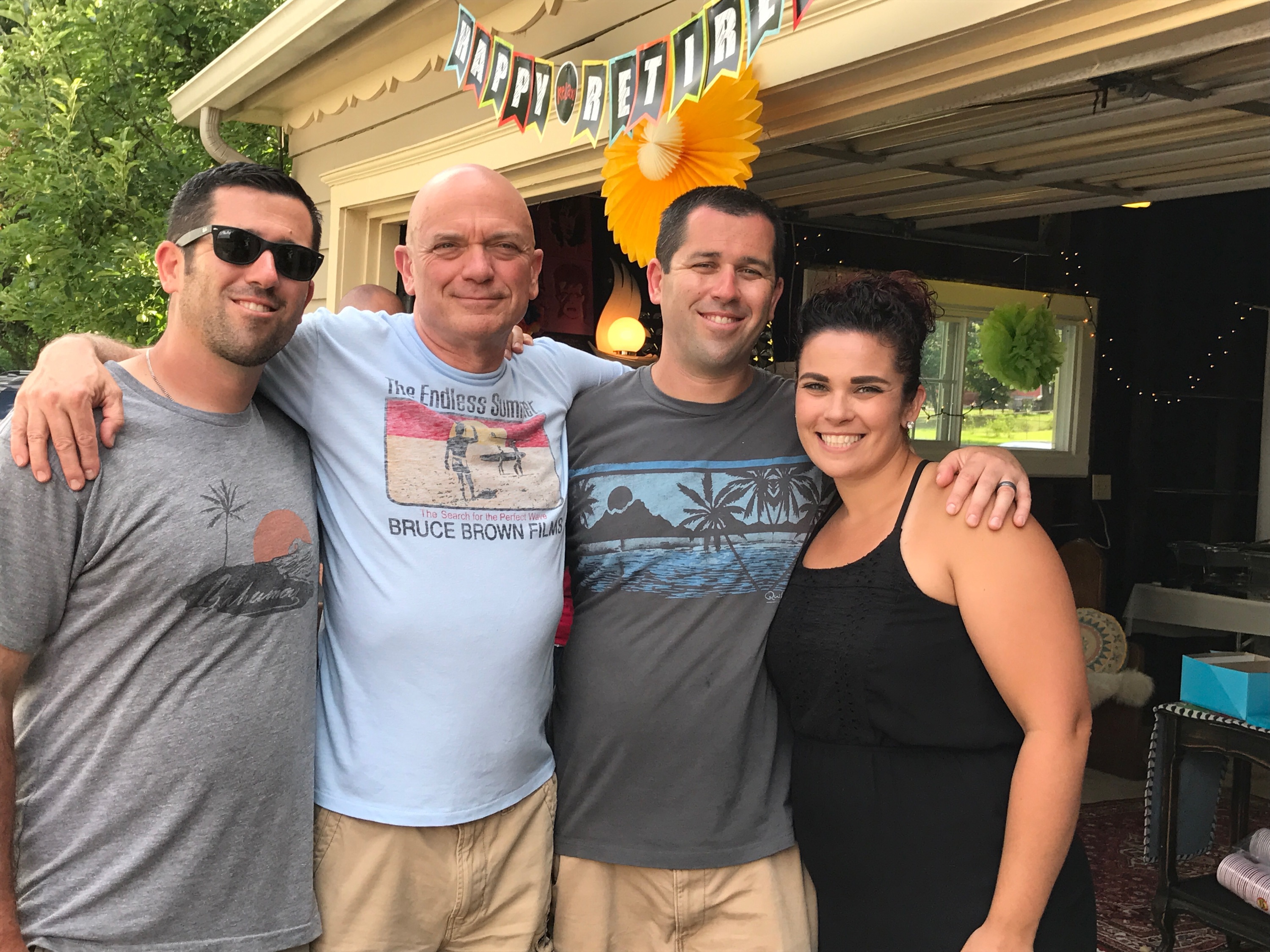
Joe Gorman with his three children: (from left) Keith, Sean, and Rachel.
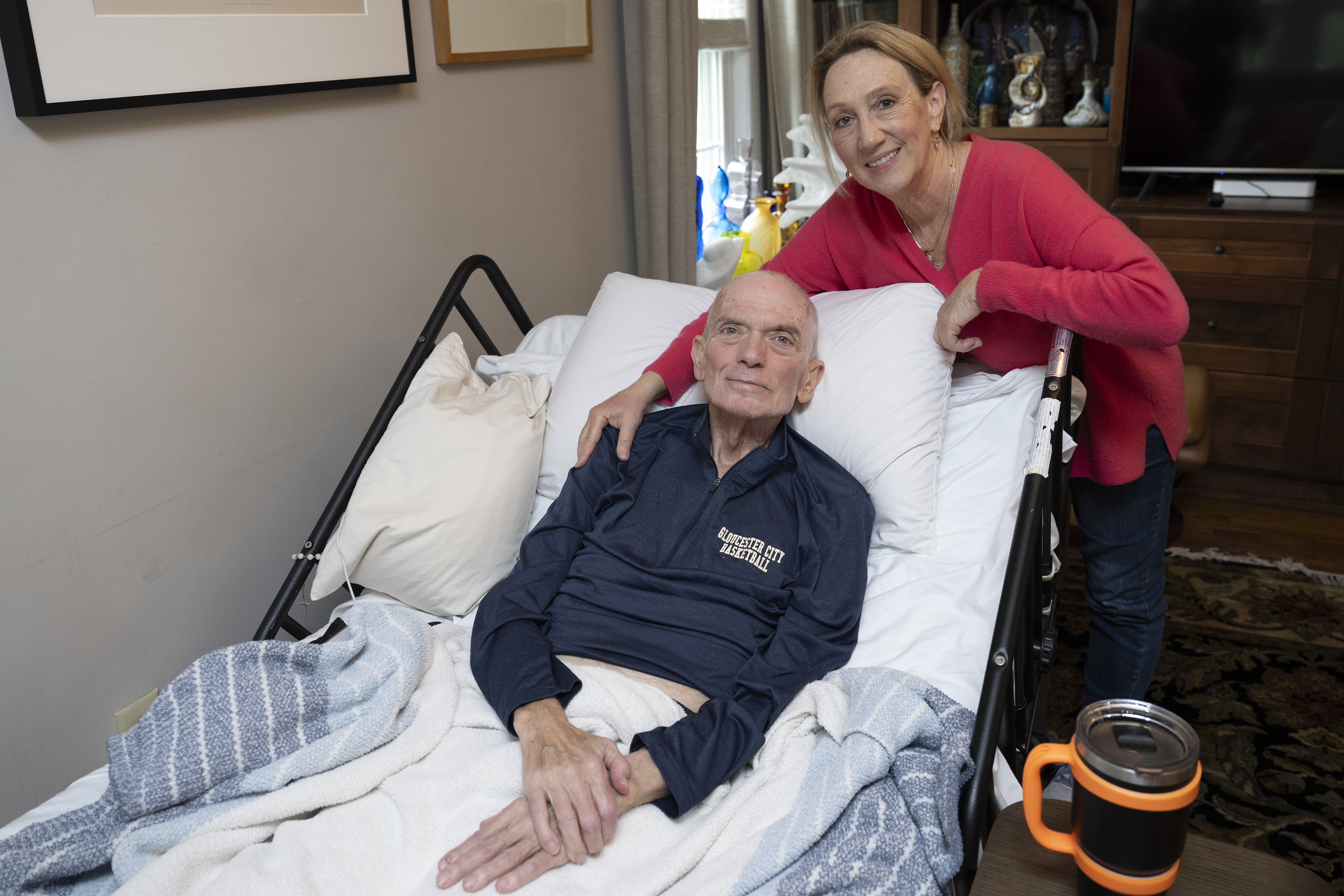
Joe Gorman and his wife, Colleen, on Nov. 5. He died six days later.


GLOUCESTER CITY — If sainthood could be won with a fight, if the process called for grit and passion alongside proof and paperwork, the people of this scrappy town would have immortalized Joe Gorman’s smiling, blue eyes in stained glass long before he died.
Joe was a lifelong resident, the oldest of nine who, as kids, all fit, somehow, into a Victorian twin on Monmouth Street with one bathroom. Every front window looked out to St. Mary’s Roman Catholic Church, a Gothic beauty in bluish-gray sandstone, with a steeple that cast shadows on their house.
Joe was a student and altar boy here in the “Holy City” and, later, a longtime teacher, guidance counselor, historian, author, and coach at three city schools.
In the weeks before and after Joe Gorman’s death, countless students, colleagues, family members, and even a pizza shop owner said he transcended worldly titles. They called him an angel, a saint, an empath who used an inner light to ignite one in hundreds, perhaps thousands, of people there.
“Joe saw something in me that I couldn’t see in myself,” former student Kristin Houser-Meyer told me.
Joe paid for students’ prom tuxedos and jaywalking tickets. He cut checks so they could record albums, wrote letters to judges. If students were pregnant, he drove schoolwork and groceries to their house. When he learned Houser-Meyer was living alone in Gloucester at age 15, Joe told her to pack.
“You’re coming to live with us,” he told her.
Houser-Meyer spent about two years living with Joe, his late wife, Joanne, and their three kids, Sean, Keith, and Rachel, in a brick house on Barnard Avenue. She graduated from Gloucester City High School in 1990 and spent decades as an ER nurse.
“Joe didn’t just change my life. He saved it,” she said. “He gave me a future I might never have found on my own.”
When it came to Joe Gorman, it seems the only thing people in Gloucester City didn’t want to say was “goodbye.”
The last house
Joe lived in a handful of Gloucester City homes during his 72 years, most within walking distance of one another. Some sat on opposite sides of the railroad tracks, on streets with paint-splattered work trucks and corner bars. Joe’s last home was on Greenwood Avenue, close enough to Gloucester High, where he was a guidance counselor, coach, and English teacher for 36 years, to hear the Lions score touchdowns.
On Nov. 11, while silvery clouds rolled over the nearby Delaware River, Joe lay in a hospital bed in the living room there. He was surrounded by art and stacks of books. Candles flickered, and Sonny Rollins and Bob Weir played in the background. His wife, Colleen Riccio-Gorman, was by his side, along with his children and other family members.
Around 8 p.m., after years of surgeries and complications, Joe Gorman’s heart gave out. His younger sister, Ann, touched on the irony that someone with “the kindest and most generous heart was genetically cursed with bad genes.”
Joe and I were Facebook friends for almost 20 years, and, like others, I appreciated the posts he shared and the adoration they received. We traded messages over the years, and in 2020, when I covered a Black Lives Matter march in Gloucester City, I reached out, knowing Joe could best explain how the city was evolving.
I messaged Joe again, around Labor Day, seeking to finally write a long-overdue profile of him. He had recently undergone another heart procedure, but I assumed he’d pull through. I envisioned meeting him at a Gloucester football game, so I could see him receive his flowers in person.
Colleen didn’t think it could happen. Time was running out.
People had been dropping by that living room almost daily while the leaves turned. Some walked, others drove 1,000 miles. Joe wasn’t eating much. He tired quickly, and Colleen figured he would have about an hour to talk.
I also have deep stakes in Gloucester City. I didn’t realize how deep they would be until I met Joe for the first and last time in that living room on Nov. 5.
Joe wore a Gloucester High basketball shirt. He was very thin, his voice barely above a whisper, but when I sat beside him and began recording, I felt his light turn toward me.
Before I asked questions, Joe spoke about my grandmother, Mary Ann Nark. She was a longtime public nurse in Gloucester and the school nurse at Gloucester Catholic High School. Joe graduated from the school in 1972. I was Class of 1995.
“I can still see her face,” he told me. “She was so precious.”
I recalled her face too, the smell of her Trident gum when she kissed my cheek in her Gloucester City rowhouse filled with books. Joe and I had the same chemistry teacher at Gloucester Catholic, too: my dad, Bob Nark. Joe was a fan of my dad’s teenage rock band, the Cautions. My dad played guitar, and my uncle Tom Young was the drummer.
“He was pretty famous,” Joe said of my dad.
My grandmother was so proud of my dad and his music, Joe said. He told me she’d be proud of me too, and that caught me off guard. I felt a lump in my throat, wondering how Joe knew I needed to hear that.
“Little did anyone know that stream would keep flowing down the mountain, to this day, with you sitting beside me, all these years later,” he said.
Shaped by the church
When I finally steered the conversation back to Joe and his effect on people, he said it stemmed from the grace he witnessed as a child in Gloucester City.
“I think I never assumed in my lifetime that I was better than anyone, because I never felt that way,” he said.
Joe was Charles and Sally Gorman’s first child, born in Camden on Jan. 6, 1954. He arrived on Monmouth Street shortly after and was baptized less than 100 yards away, in St. Mary’s. Seven sisters and a brother followed.
The family didn’t own a car, Joe said, and they struggled — but only financially.
“How my mom held that together, I’ll never know. It was force of will,” he said.
St. Mary’s wasn’t just a view or a place to kneel and stand on Sundays. The Gormans were emotionally tethered to St. Mary’s for life.
“They felt it had saved them. Not saved their souls, but saved the family from going down the drain, economically,” he said.
Msgr. Edward B. Lucitt, the longtime pastor at St. Mary’s and dogged supporter of Gloucester City, looked out for the family, Joe told me. He paid utilities and tuition without keeping tabs. Whatever people think of Joe, he credited to Lucitt.
“The way he loved this town, I assumed I should love it that way, too, and be just as protective of it,” he said.
Those struggles created the ethos Joe lived by, something he imparted to his children and to students barely hanging on in a town with some rougher edges.
“The work that Msgr. Lucitt established here boils down to something pretty simple,” he said. “You pull the next guy up the ladder.”
A life in schools
In a biography from his 2024 Gloucester Catholic High School Hall of Fame induction, Joe said he was a “rudderless ship” before he entered the narrow hallways on Ridgeway Street.
That changed quickly, and, according to his obituary, Joe was voted “most reliable” at the school.
“I came to love every single day I was there,” he said in the bio.
Longtime friend Mike DiGiacomo, a baseball star at Gloucester Catholic, said Joe would walk to his home in nearby Westville to help him study for the SATs.
“Joe never did anything for compensation, except for maybe a good Italian meal at my house,” DiGiacomo told me. “He had a knack for finding the people that needed help but maybe didn’t know how to ask for it.”
Joe also met his high school sweetheart, Joanne Convery, at the school, and they married in 1978.
After GCHS, Joe became the first Gorman to go to college, entering Rutgers University on the Educational Opportunity Fund, which was created to help low-income students. The Gormans still didn’t have a car, so Msgr. Lucitt dropped Joe and his knapsack in New Brunswick, ending their trip with strong words.
“He told me I could change my family’s future if I stuck with it,” Joe recalled.
At Rutgers, Joe studied English and became a star in the EOF program, so popular with administrators that they asked him to be a tutor and found ways to pay him more than they should have.
During summers, he worked in Wildwood.
More than a few people at Rutgers and back home, in Gloucester City, knew that Joe was a natural teacher, and they encouraged him to follow that path. He began teaching at his alma mater, St. Mary’s grade school, in the late 1970s. He eventually taught his sister Ann, when she was in eighth grade, assigning her Tom Wolfe’s The Electric Kool-Aid Acid Test, much to the dismay of their parents.
“He wanted to expand my horizons,” Ann told me with a laugh.
Joe taught at Gloucester Catholic for two years, then moved to the crosstown rival, Gloucester High, about a mile east. He was a bit nervous after spending a lifetime in Catholic schools, but found that “teens are teens.”
“I realized I was exactly where I should be, probably the best place to carry out Msgr. Lucitt’s vision of helping people up the ladder,” he told me in his living room. “I just loved every minute of it.”
Joe didn’t raise his voice, didn’t need to demand attention from students. He always knew when they needed something.
“The most selfless man you’ll ever meet,” my cousin Kevin Young, a graduate and current teacher at Gloucester High, told me.
When Tom McConnell, a special education teacher at Gloucester High, was starting a wrestling program, he turned to Joe to wax about the city’s hard-nosed lore.
“While Gloucester had no history of wrestling, Joe told them it has a history of toughness, decades of stories of families who did great things here,” McConnell said.
According to the U.S. Census, 19.5% of Gloucester residents live below the poverty line, almost double New Jersey’s rate. As a guidance counselor, Joe often met students with graver concerns than grades.
“Yes, I faced big problems almost daily,” he told me. “But I can relate to the struggling kid.”
Eventually, Joe went back to the classroom, then retired in 2017 after four decades as an educator in Gloucester City.
“It never felt like work,” he told me.
Like Joe and Joanne, all three Gorman children are educators in Gloucester City.
Grief and love
A few days before Joe’s funeral, I met Colleen on a picturesque afternoon at Proprietor’s Park, which looks out to the Delaware River and the federal-green expanse of the Walt Whitman Bridge. Joe loved the park, she told me, and he lived in a rowhouse that overlooked it when they first started talking in 2011.
They were both widows.
Colleen’s first husband, Bob Riccio, was also an educator, and he died of brain cancer in 2008. Joanne Gorman was a lifelong teacher, too. She died in 2003 after a long battle with MS.
“I feel Joanne’s soul whenever I’m in the presence of my children and my grandchildren,” Joe wrote in a long Facebook post on the 23rd anniversary of her death.
The despair, he wrote, nearly crushed him.
“Joanne was truly beloved in this community,” Colleen said.
Joe, Colleen told me, wasn’t sure he could date again, but they continued talking — finding solace, then love in one another. Colleen and Joe were married in Bristol, where she grew up, in 2019, and they honeymooned in Paris and London.
“Joe and I both felt that our meeting was very likely orchestrated by our spouses,” she said.
When they moved to Greenwood Avenue, Colleen grew accustomed to constant visitors, former students young and old, who still sought his advice. She hopes they’ll still visit.
“The loneliness hasn’t really set in yet,” she told me by the river.
Joe and Colleen also took students, family, everyone basically, over to Santucci’s Pizza in the Italian Market. Joe was religious about their pizza, and owner Alicia Santucci struggled to keep her composure when talking about him.
“I used to tell him, ‘Joe, if there is a day you don’t show up, I’m calling for a wellness check,’” she told me.
Santucci dubbed Nov. 12 “Joe Gorman Day” and, in a social media post, encouraged everyone to practice acts of kindness in his honor. They also sent a slew of pizzas over the bridge to Gloucester City to feed the Gormans.
“He really fueled the good in us,” she said.
Goodbye
On Nov. 22, the day of Joe Gorman’s funeral, I drove to Gloucester City hours before Mass at St. Mary’s. I drove by homes he lived in, including a big, lovely house near the basketball courts where he raised his kids with Joanne.
I bought a coffee and walked toward McCann-Healey Funeral Home, where John Healey was preparing to drive all the flowers — many Gloucester High blue and gold — and hundreds of photo displays to the church a few blocks away. A day earlier, about 1,500 people had lined up outside to pay respects.
When I asked John’s mother, Rosemary Healey, about Joe, she made me smile.
“Honey, let me tell you something: If Joe Gorman didn’t go straight to heaven, you and I don’t stand a chance.”
My grandmother’s viewing was held at McCann-Healey in 1999, and I walked to Chambers Avenue, where she raised three young kids, alone. The day of Joe’s funeral, it looked mostly the same, and I wished I could go inside again.
The doors were open over at Gloucester Catholic, the gymnasium full of students, parents, and alumni gathered for a scholarship breakfast. There was a moment of silence for Joe.
Before I left, I walked up three flights of stairs to see my dad’s old chemistry lab. He thinks Joe earned an “A” in his class. I finished with a “B.”
At church, I said hello to my aunt, uncle, and cousin, who were leaving 11:30 a.m. Mass. A crowd was forming for the second viewing, and I waited for my dad so we could go in together.
Inside, he and I shuffled up and down the pews, past all the saints in stained glass, stopping every minute or so when someone said, “Bob Nark?” We looked at hundreds of photos of Joe, alongside his loved ones and students over the decades. He had 11 grandchildren.
“The most loved man in town,” my dad said to me.
Joe lay in his casket wearing a Grateful Dead shirt, with a Gloucester High blanket around his waist. We gave our condolences and found a pew in the back. The organist slipped in renditions of “Stairway to Heaven” and “In My Life,” and Deacon Joe Rafferty, in his homily, said the “world needs more Joes.”
Joe’s son, Sean Gorman, Gloucester High’s principal and the city’s superintendent, gave the eulogy. He got big laughs, talking about students sleeping on the family couch, and tears, too.
“When you were around Joe Gorman, every single moment, you always felt a little closer to the sun,” Sean said.
Sean ended by saying, “God bless Gloucester City, forever and ever.”
The stained glass dimmed. My dad left after Communion so he wouldn’t have to drive home in the dark. I sat there, pondering his mortality, knowing I’d visit this beautiful church at least one more time.
I regretted not doing this story sooner and worried I hadn’t learned enough about Joe, that we spent too much time talking about my ties to Gloucester. A mentor of mine, former Gloucester Catholic principal Ed Beckett, sat a few pews ahead, and I was comforted by something he’d said when we spoke about Joe a week earlier.
“His light shines on.”
Maybe I learned exactly who Joe Gorman was when he shone his light on me in his living room.
Outside, I stood by some bagpipers and a drummer, and whatever Irish I have in my DNA lost it when they began playing “Danny Boy.” A woman saw me shielding my face with a notepad and put her hand on my back. I felt embarrassed to be a reporter in tears, so I stepped across the street.
Mourners filed through St. Mary’s big wooden doors and gathered on the steps and the sidewalk. They stood near the rectory and the statue of the Blessed Mother, crowded onto Monmouth Street.
“That’s how you say goodbye to Joe Gorman,” his sister, Bernadette, said, wiping away tears.
The bells tolled. Joe’s grandsons carried his casket to the hearse. The drummer slowed his rhythm, then stopped, like a great big heart thumping its final beats.
jnark@inquirer.com
jasonnark
(215) 313-3102